

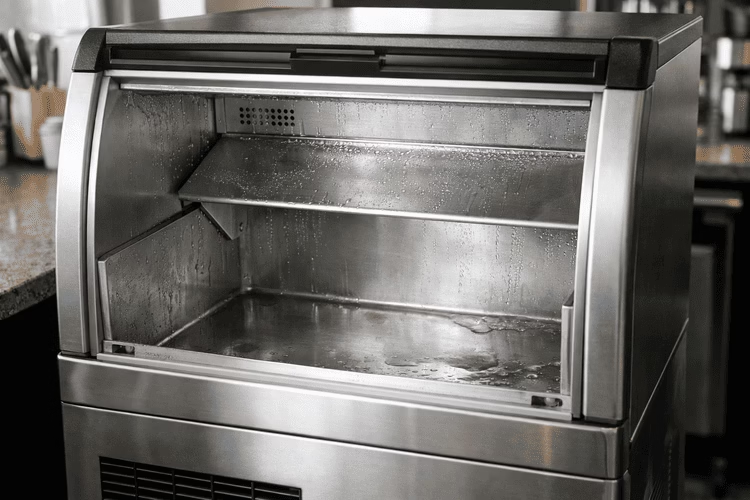
Feeling lost because of a breakdown? In fact, a whole range of issues arise right away when the ice maker breaks down. After all, you can’t go to the beach in the summer. It’s hard to imagine being there without a cool cocktail with ice or some ice cream. By the way, it’s an essential item in the kitchen. If you still can’t figure out the cause on your own, then you need to take a closer look. Today we’ll talk about the first signs of a breakdown and how to prevent it. So, don’t give up!
How a Scotsman Ice Machine Works
In short, Scotsman ice makers operate as follows: water is fed onto the cooled surface of the evaporator, where it gradually freezes, turning into clear ice. Once the freezing cycle is complete, the system activates the defrost mode. Note that this is where hot gas comes into play. This is necessary to separate the ice cubes from the mold and direct them into the storage bin. The entire process is controlled by sensors that monitor the water level, temperature, and container fill level.
Most Common Reasons a Scotsman Ice Maker Stops Producing Ice
Obviously, there aren’t that many reasons why glitches occur. However, it’s important to spot warning signs early on. Sometimes even a seemingly harmless detail can be the start of serious problems. That’s why we’ve put together a guide for beginners. So, keep reading!
Water Supply Issues
This is most often caused by a drop in water pressure. It is not uncommon for the inlet valve to be clogged or for the water supply to be shut off. The safety system will turn off the ice maker right away because the pump could get too hot. Note that you should check the hoses for kinks.
Dirty or Clogged Filters
It is well known that filters remove impurities and chlorine from water. However, over time, they accumulate sediment. If the filter is dirty, water flow is greatly reduced, which causes hollow ice cubes to form. In some cases, this can cause the cycle to stop completely. Furthermore, such areas provide an ideal environment for bacterial growth.
Temperature or Cooling Problems
For the ice maker to function properly, heat must be continuously dissipated. If the condenser is clogged with dust, these states are unsafe. Specifically, at temperatures above 32°C, the refrigerant does not have time to cool down. This causes the compressor to overheat and triggers the safety relay.
Sensor or Control Board Failures
The latest Scotsman models feature a digital control system. If the water level sensor or ice thickness sensor fails, the controller will malfunction. This means that the machine will barely fill with water, even though the display indicates otherwise. In such cases, a professional inspection of the electrical circuits or the board’s firmware is required.
Why Ice Production Drops Before It Stops Completely
Actually, everything happens gradually and almost imperceptibly. Meanwhile, a drop in performance indicates that scale has built up on the evaporator. Note that the layer of salts acts as an insulator. In other words, it slows down the heat exchange process. Ice takes longer to form, becomes opaque, or takes on an irregular shape. Another possible cause is a small fridge leak, which poses a health hazard.
When You Need Immediate Professional Repair
Of course, in many cases you can handle the issue on your own. However, there are certain issues that cannot be ignored. Therefore, don’t delay visiting a service center if you notice any of the following:
The unit is making unusual loud noises or a loud humming sound;
Error indicators are flashing continuously on the control panel;
There are signs of water leakage inside or under the appliance;
The compressor is hot to the touch, but the freezing cycle does not start.
Remember that preventive maintenance is a direct way to save your time and money. It is not uncommon for faults to develop over months until they lead to consequences. Trying to fix something yourself usually only leads to disappointment. Often, your skills aren’t enough.
How Regular Maintenance Prevents Ice Machine Failure
Please note that timely maintenance is the only way to prevent unexpected breakdowns. These measures include disinfecting the system, cleaning the condenser, and replacing the filter cartridges. Our experts suggested performing these procedures every 6 months. Plus, preventive maintenance not only extends the service life of expensive equipment but also guarantees perfectly clean ice, which is always a welcome bonus.
If your unit still isn’t producing ice, it’s best to rely on professional Appliance Repair Services to diagnose and fix the issue quickly and safely.
